
Curious About Islam? Start Here.
Whether you're simply curious or looking to understand Islam more deeply, we have resources to help you explore its beliefs, teachings, and practices at your own pace.
Common Questions
About Islam
Find straightforward answers to common questions about Islam, its beliefs, and its teachings.
Islam is an Arabic word which means peace, submission, and obedience. It also means acceptance and commitment to abide by the teachings and guidance of God.
One of the beautiful names of God is As-Salam (The Peace). Islam also means to be at peace with God and His creatures. Being at peace with God implies complete submission to His will, Who is the source of all purity and goodness.
Being at peace with His creatures implies living in peace with one’s self, with other people, and with the environment. Thus, Islam is a total system of living in peace.
Islam is the same message and guidance which God revealed through all His Prophets to every people throughout the history of mankind.
One who follows Islam is called a Muslim, an Arabic word which means “the one who submits to the will of God.”
References: Qur’an 2:112; Qur’an 3:19; Qur’an 5:3; Qur’an 16:36; Qur’an 21:25; Qur’an 59:23; Sahih Muslim 8 — Hadith of Jibril; Sahih Muslim 16b — Five Pillars of Islam.
Muslims believe in one God (Allah), the same God worshipped by Abraham, Moses, Jesus, and the other prophets, peace be upon them all. Muslims believe that God has no partners or equals and that He alone is worthy of worship.
Muslims believe that God has sent prophets and messengers throughout history, including Adam, Noah, Abraham, Moses, David, Solomon, Jesus, and Muhammad (peace be upon them all). Muslims believe that Muhammad ﷺ was the final prophet and messenger.
Muslims also believe in God’s revealed scriptures, including the Torah, Psalms, Gospel, and Qur’an, while believing that the Qur’an is God’s final and preserved revelation.
Muslims believe in angels, the Day of Judgment, resurrection, and divine decree, and that every person is accountable to God for their choices and actions.
At the heart of Islam is a simple message: worship God alone, live with faith and righteousness, treat others with justice and compassion, and prepare for the life to come.
References: Qur’an 2:177; Qur’an 2:285; Qur’an 4:136; Qur’an 33:40; Hadith of Jibril — Sahih Muslim.
Allah is the Arabic name for the one true God, the Creator and Sustainer of all that exists. Muslims believe that Allah is the same God worshipped by Abraham, Moses, Jesus, and all of the prophets. He has no partners, children, or equals, and nothing is comparable to Him.
The Qur’an teaches that Allah is One, eternal, and completely independent, while everything in creation depends upon Him. He is the Most Merciful and Most Compassionate, and He is also perfectly just. Muslims believe that Allah knows all things, hears every prayer, and is closer to each person than anyone else.
At the heart of Islam is Tawhid: that Allah alone is worthy of worship.
The Qur’an says:
“Say, He is Allah—One. Allah—the Sustainer.
He has never had offspring, nor was He born.
And there is none comparable to Him.”
— Qur’an 112:1–4
References: Qur’an 2:255; Qur’an 21:25; Qur’an 50:16; Qur’an 59:22; Qur’an 112:1–4.
The Qur’an is the holy book of Islam and the final revelation from Allah (God). Muslims believe it is the literal word of Allah, revealed in Arabic to the Prophet Muhammad ﷺ through the Angel Gabriel over approximately 23 years.
The Qur’an is a guide for humanity, addressing faith, worship, morality, personal conduct, family and community life, and the relationship between people and their Creator. It also tells the stories of many earlier prophets, including Adam, Noah, Abraham, Moses, and Jesus (peace be upon them all).
Muslims believe that the Qur’an has been preserved in its original Arabic form since its revelation and is recited and memorized by Muslims around the world. Its 114 chapters, called surahs, vary in length and cover a wide range of spiritual, moral, and practical guidance.
The Qur’an says:
“This is the Book! There is no doubt about it—a guide for those
mindful of Allah.”
— Qur’an 2:2
References: Qur’an 2:2; Qur’an 12:111; Qur’an 15:9; Qur’an 16:89; Qur’an 17:106; Qur’an 26:192–195; Sahih al-Bukhari 4986.
Muhammad ﷺ was the final prophet and messenger of Allah (God) in Islam. Muslims believe that Allah chose him to deliver His final revelation, the Qur’an, and to call humanity to worship Allah alone.
Muhammad ﷺ was born in Makkah around 570 CE. At the age of 40, he began receiving revelation through the Angel Gabriel. Over the next 23 years, he conveyed the Qur’an and taught people how to put its guidance into practice through his words, actions, and example, known as the Sunnah.
Muslims do not worship Muhammad ﷺ or consider him divine. Rather, they love and honor him as Allah’s servant, messenger, and final prophet, following his example as a model of faith, compassion, honesty, patience, and justice.
The Qur’an says:
“Muhammad is the Messenger of Allah and the seal of the prophets.”
— Qur’an 33:40
“We have sent you only as a mercy to the worlds.”
— Qur’an 21:107
References: Qur’an 3:144; Qur’an 7:158; Qur’an 21:107; Qur’an 33:40; Qur’an 48:29; Sahih al-Bukhari 3.
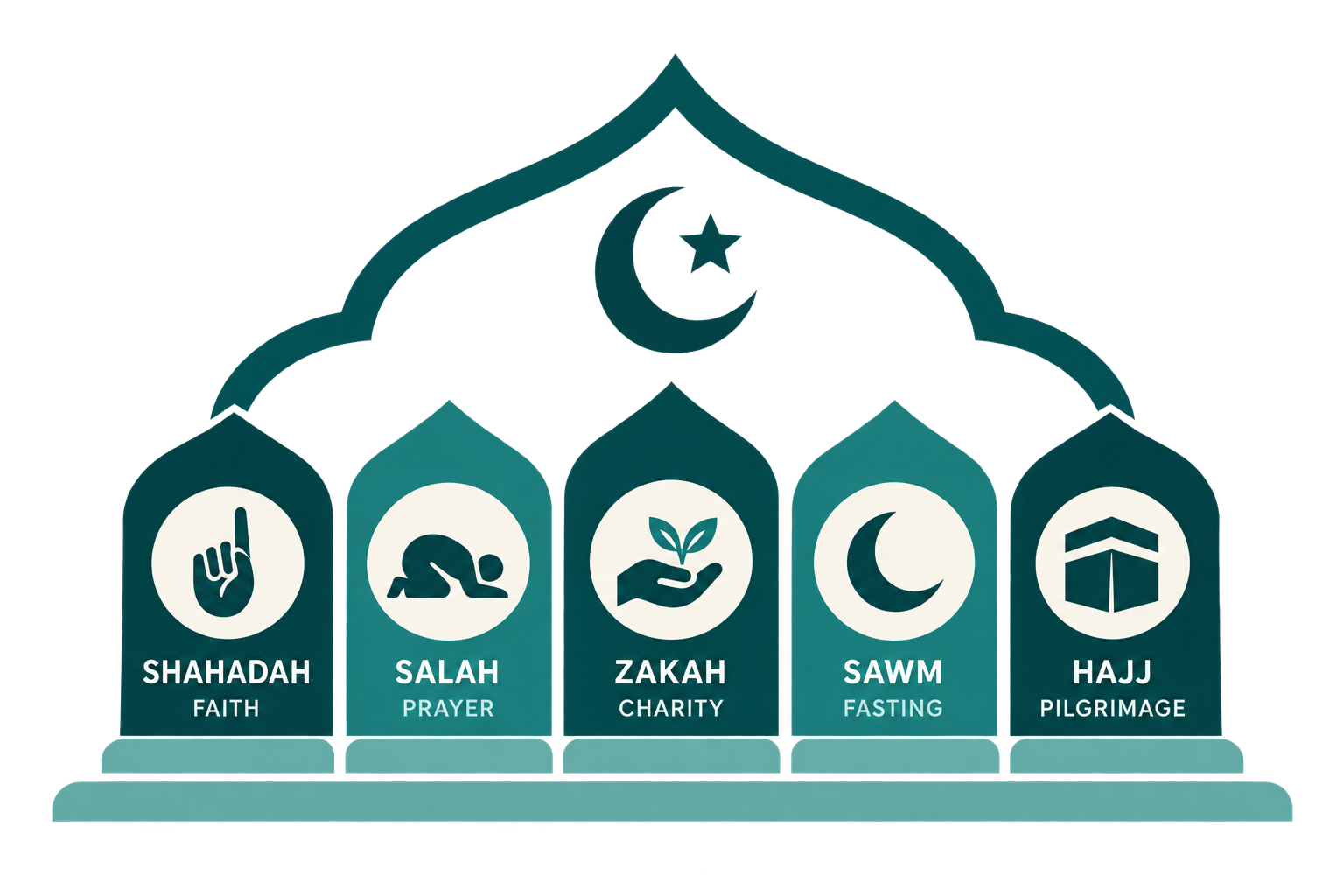
The Five Pillars of Islam are the five fundamental acts of worship and practice that form the foundation of a Muslim’s religious life. Together, they provide a framework for a Muslim’s relationship with Allah and their responsibilities toward others.
Shahadah (Declaration of Faith) — Affirming that there is no deity worthy of worship except Allah and that Muhammad ﷺ is His messenger.
Salah (Prayer) — Performing the five daily prayers as an act of worship and remembrance of Allah.
Zakah (Charity) — Giving a required portion of qualifying wealth to those entitled to receive it, helping purify one’s wealth and support those in need.
Sawm (Fasting) — Fasting from dawn until sunset during the month of Ramadan, abstaining from food, drink, and other prohibited acts while focusing on worship and self-discipline.
Hajj (Pilgrimage) — Making the pilgrimage to the Ka‘bah in Makkah at least once in a lifetime for Muslims who are physically and financially able to do so.
These pillars provide a framework for faith, worship, discipline, charity, and connection with Allah, while encouraging Muslims to carry their faith into everyday life.
References: Sahih al-Bukhari 8; Sahih Muslim 16 — the Hadith of Ibn Umar describing Islam as being built upon five foundational practices.
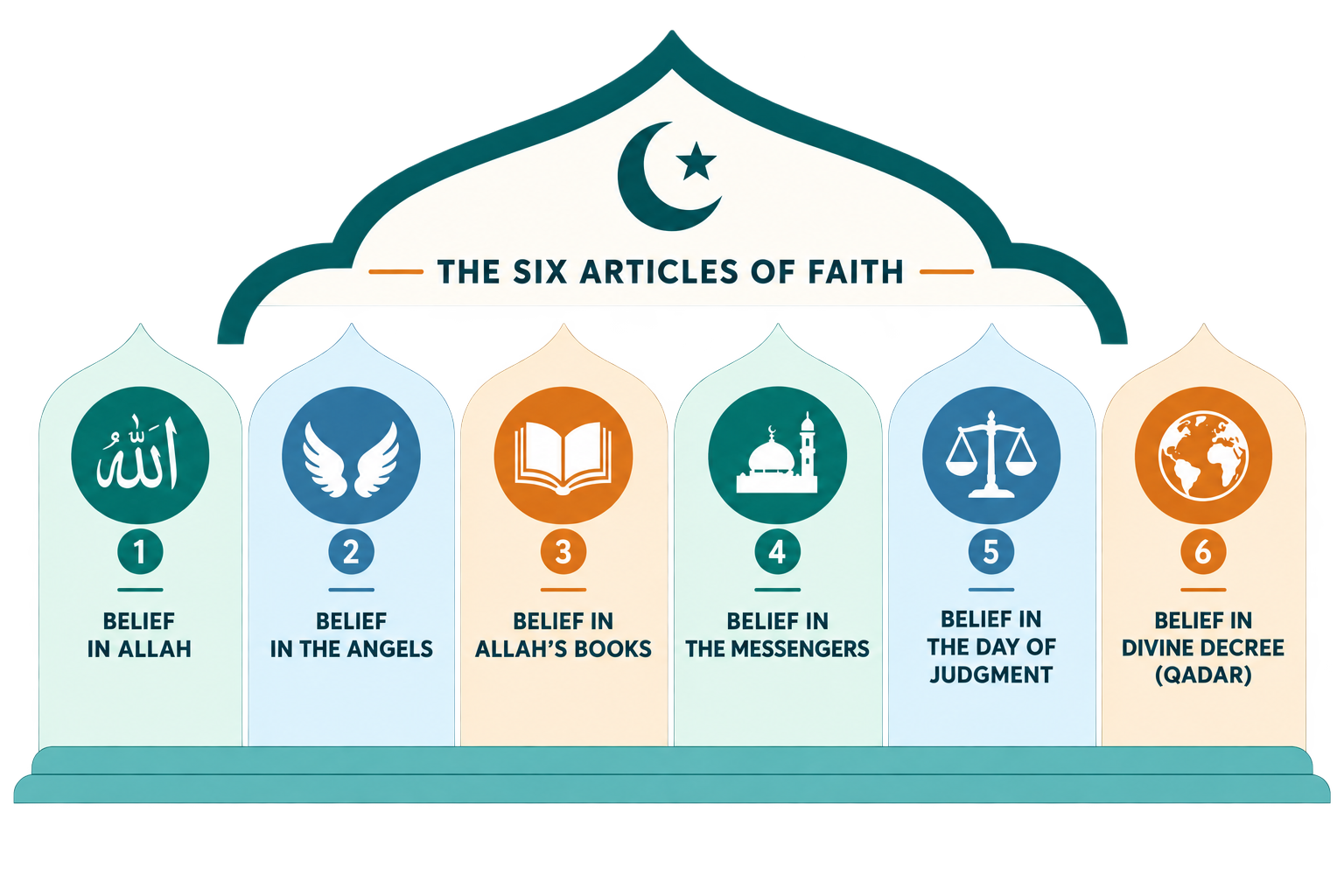
The Six Articles of Faith (Iman) are the fundamental beliefs that Muslims affirm as part of their faith.
Belief in Allah — Believing that Allah is the one true God, without partner or equal.
Belief in the Angels — Believing that angels are creations of Allah who carry out His commands.
Belief in Allah’s Books — Believing that Allah revealed scriptures to His prophets, including the Torah, Psalms, Gospel, and Qur’an, with the Qur’an being His final revelation.
Belief in the Messengers — Believing that Allah sent prophets and messengers to guide humanity.
Belief in the Day of Judgment — Believing that all people will be resurrected and held accountable for their beliefs and actions.
Belief in Divine Decree (Qadar) — Believing that Allah has complete knowledge and authority over His creation.
References: Sahih Muslim 8a (Hadith of Jibril); Qur’an 2:285; Qur’an 4:136.
Muslims believe that Allah sent prophets and messengers throughout history to guide humanity, teach people to worship Him alone, and call them toward righteousness. Muslims believe in all of Allah’s prophets and messengers and do not reject any of them.
The Qur’an names 25 prophets specifically, including Adam, Idris, Nuh, Hud, Salih, Ibrahim, Lut, Isma'il, Ishaq, Ya'qub, Yusuf, Ayyub, Shu'ayb, Musa, Harun, Dhul-Kifl, Dawud, Sulayman, Ilyas, Al-Yasa', Yunus, Zakariyya, Yahya, Isa, and Muhammad ﷺ.
These are not necessarily all of the prophets Allah sent. Muslims therefore believe in all of Allah’s prophets, including those whose names and stories are not known to us.
The fundamental message of the prophets was the same: worship Allah alone and follow His guidance.
References: Qur’an 2:136; Qur’an 2:285; Qur’an 4:163–165; Qur’an 6:83–86; Qur’an 21:25; Qur’an 33:40; Qur’an 40:78.
Muslims believe that Allah has communicated His guidance to humanity through revelation, sending prophets and scriptures to different peoples throughout history.
Muslims believe that the original revelations given to prophets such as Moses, David, and Jesus came from Allah and therefore respect the Torah (Tawrah), Psalms (Zabur), and Gospel (Injil) as originally revealed.
Islam teaches that the scriptures available today are not identical in every respect to the original revelations given to those prophets. The Qur’an describes itself as the final revelation from Allah and a criterion over the earlier scriptures, confirming the truth that remains in them while providing final, authoritative guidance for humanity.
This means Muslims do not reject the prophets or the original revelations that came before the Qur’an. Rather, they believe in a continuous chain of divine revelation, culminating in the Qur’an and the message of Muhammad ﷺ.
References: Qur’an 2:136; Qur’an 3:3–4; Qur’an 5:44–48; Qur’an 15:9; Qur’an 4:136.
Muslim Beliefs & Practices
Explore the beliefs and practices that shape Muslim life, from the Five Pillars and daily prayer to fasting, charity, pilgrimage, and other expressions of faith. Learn how these practices connect Muslims to Allah and guide everyday life.
Why do Muslims pray five times a day?
Muslims pray five times a day because Allah has commanded regular prayer throughout the day. Salah is one of the Five Pillars of Islam and gives Muslims regular opportunities to worship Allah and remember Him.
The five daily prayers were prescribed to the Prophet Muhammad ﷺ during the Isra and Mi'raj, the Night Journey and Ascension. According to Islamic tradition, during this event the Prophet ﷺ was initially instructed to establish 50 prayers each day. Allah then reduced the obligation to five daily prayers, while their reward remained equivalent to fifty.
The five prayers are:
• Fajr — dawn
• Dhuhr — midday
• Asr — afternoon
• Maghrib — just after sunset
• Isha — night
Qur’an 4:103; Sahih al-Bukhari 349; Sahih Muslim 162.
What is salah?
Salah is the formal, ritual prayer Muslims perform as an act of worship to Allah. It includes specific movements, recitations, and supplications and is performed at designated times throughout the day.
Muslims perform five daily prayers, which are one of the Five Pillars of Islam. Salah can be performed individually or in congregation, and Muslims face the Ka‘bah in Makkah when praying.
The Qur’an repeatedly instructs Muslims to establish prayer:
“Establish prayer for My remembrance.”
— Qur’an 20:14
Why do Muslims face Makkah when they pray?
Muslims face the Ka‘bah in Makkah when performing salah. This direction is called the qiblah.
According to the Qur’an, Allah instructed the Prophet Muhammad ﷺ and the Muslims to turn toward the Sacred Mosque (Masjid al-Haram) in Makkah. Before this command, Muslims prayed facing Jerusalem.
Facing the same direction gives Muslims around the world a shared direction of worship. Muslims do not worship the Ka‘bah itself; they worship Allah alone.
“So turn your face toward the Sacred Mosque, and wherever you are, turn your faces toward it.”
— Qur’an 2:144
Qur’an 2:142–150.
What is wudu, and why is it performed?
Wudu is a ritual washing that Muslims perform before salah. It involves washing specific parts of the body, including the hands, mouth, nose, face, arms, head, and feet.
Wudu is performed as a means of purification before prayer and other acts of worship. If someone loses their state of ritual purity, they generally perform wudu again before praying.
The Qur’an describes the steps of wudu:
“O believers! When you rise up for prayer, wash your faces and your hands up to the elbows, wipe your heads, and wash your feet to the ankles.”
— Qur’an 5:6
Wudu is not simply about physical cleanliness—it also prepares a person mentally and spiritually for prayer.
Qur’an 5:6; Sahih al-Bukhari 135.
How does someone begin learning how to pray?
Learning salah takes practice, and no one is expected to know everything right away. A beginner can start by learning the basic steps of wudu, the movements of salah, and a few short prayers and passages to recite.
A good place to start is by learning one prayer at a time, practicing the movements, and gradually learning the required recitations. Muslims can also learn by praying alongside others at the masjid or asking someone experienced to demonstrate the prayer.
The ASIA Center can help those who are new to Islam or simply want to learn more about how Muslims pray. You are welcome to reach out to the masjid or speak with someone in the community for guidance.
“So ask the people of knowledge if you do not know.”
— Qur’an 16:43
Qur’an 2:238; Qur’an 16:43; Qur’an 20:114; Qur’an 29:45; Qur’an 39:9; Sahih al-Bukhari 631.
What should someone do if they do not know how to pray yet?
If you do not know how to pray yet, don’t worry—you can learn gradually. Start by learning the basic movements and a few of the required recitations, then build from there with practice.
Someone who is new to Islam can ask a knowledgeable Muslim for help, attend the masjid, or learn alongside others. The important thing is to begin learning rather than feeling that you have to know everything before you start.
If you are learning about Islam or are a new Muslim, ASIA Center is happy to help you learn the basics of salah and answer questions along the way.
References: Qur’an 16:43; Qur’an 20:114; Sahih al-Bukhari 631.
Why do Muslims fast during Ramadan?
Muslims fast during Ramadan, the ninth month of the Islamic calendar, because Allah has commanded believers to fast. From dawn until sunset, Muslims abstain from food and drink, as well as other things that invalidate the fast.
Fasting is a way to develop self-discipline, gratitude, and awareness of Allah, while also encouraging compassion for those who experience hunger and hardship.
The Qur’an says:
“Fasting is prescribed for you—as it was for those before you—so that you may become mindful of Allah.”
— Qur’an 2:183
Ramadan is also significant because Muslims believe it was during this month that the Qur’an began to be revealed to the Prophet Muhammad ﷺ.
Sahih al-Bukhari 8, Qur’an 2:183-185
What is zakat?
Zakat is a required form of charitable giving and one of the Five Pillars of Islam. Muslims who meet certain financial requirements give a portion of their qualifying wealth to specific groups of people in need.
Zakat is generally calculated as 2.5% of qualifying wealth held above a minimum threshold (nisab) for one lunar year, although the calculation can vary depending on the type of wealth.
Zakat helps support people in need and encourages Muslims to use their wealth responsibly and generously.
The Qur’an says:
“Establish prayer and give zakat.”
— Qur’an 2:43
References: Qur’an 2:43; Qur’an 2:177; Qur’an 9:60; Qur’an 9:103; Qur’an 23:4; Sahih al-Bukhari 1395.
What is Hajj?
Hajj is the annual pilgrimage to Makkah and one of the Five Pillars of Islam. Muslims who are physically and financially able are required to perform Hajj at least once in their lifetime.
Hajj takes place during specific days of the Islamic month of Dhul-Hijjah and includes acts of worship such as circling the Ka‘bah (Tawaf), traveling between Safa and Marwah (Sa‘i), and gathering at Arafat.
Hajj commemorates the devotion and sacrifices of Prophet Ibrahim (Abraham), his wife Hajar (Hagar), and their son Isma‘il (Ishmael).
The Qur’an says:
“Pilgrimage to this House is an obligation by Allah upon whoever is able among the people.”
— Qur’an 3:97
References: Qur’an 2:125; Qur’an 2:196; Qur’an 3:97; Qur’an 22:27–29; Sahih al-Bukhari 8; Sahih Muslim 16.
Why do Muslims remove their shoes in the mosque?
Muslims remove their shoes before entering the prayer area of a mosque to help keep the space clean. Since Muslims often pray directly on the floor, removing shoes helps prevent dirt and other impurities from being brought onto the prayer area.
It is also connected to the idea of treating the mosque as a clean and respectful place of worship. In many mosques, shoes are removed at the entrance or before entering carpeted prayer areas.
Muslims are not required to remove shoes simply because they are in a mosque in every circumstance; the practice primarily depends on keeping the prayer space clean and following the customs of that particular mosque. ASIA Center requests that those in attendance at the mosque remove shoes before walking on carpeted areas at all times.
References: Qur’an 7:31; Qur’an 5:6; Qur’an 9:108; Sahih Muslim 282; Sahih al-Bukhari 5550; Sahih Muslim 555.
Why do Muslim women wear hijab?
Hijab refers to the Islamic principles of modesty in dress and behavior. For many Muslim women, wearing a headscarf is an important part of practicing their faith and following Allah’s guidance.
The Qur’an instructs believing women to dress modestly and to draw their coverings over their bodies. Muslims understand these verses as establishing guidelines for modest dress, while the exact style of clothing and head covering can vary among Muslim women and cultures.
Modesty is also an important part of Islamic practice for men. The Qur’an instructs believing men to lower their gaze and guard their chastity. Muslim men are also expected to dress modestly and observe their awrah, the parts of the body that Islam requires to be covered. Modesty in Islam is therefore a responsibility shared by both men and women, with specific guidelines for each.
Hijab is ultimately a personal act of worship and devotion to Allah. Muslim women may choose different styles, colors, and clothing while observing the principles of modesty.
The Qur’an says:
“Tell the believing men to lower their gaze and guard their chastity…”
— Qur’an 24:30
And regarding believing women:
“And tell the believing women to lower their gaze, guard their chastity, and not reveal their adornment except what normally appears. Let them draw their veils over their chests…”
— Qur’an 24:31
References: Qur’an 7:26; Qur’an 24:30–31; Sahih Muslim 2159a.
Why don't Muslims eat pork?
Muslims do not eat pork or pork products because Allah has prohibited them in the Qur’an. This is part of the Islamic dietary guidelines known as halal (permissible) and haram (prohibited).
The prohibition applies specifically to eating pork, rather than being afraid of pigs or avoiding them as animals. Muslims are not scared of pigs and do not believe that a pig will harm them simply by being nearby. A Muslim can encounter, see, or be around a pig without running away from it.
The prohibition of pork is ultimately a matter of religious observance and obedience to Allah. Muslims follow these dietary guidelines as part of their faith and commitment to His guidance.
The Qur’an says:
“He has only forbidden you carrion, blood, swine flesh, and what has been slaughtered in the name of anything other than Allah.”
— Qur’an 2:173
References: Qur’an 2:173; Qur’an 5:3; Qur’an 6:145; Qur’an 16:115.
Islam & Christianity
Explore the beliefs Islam and Christianity share, as well as the important differences between them. Learn what Muslims believe about Jesus, Maryam, the prophets, scripture, and the relationship between Islam and Christianity.
What do Muslims believe about Jesus?
Muslims love and honor Jesus (Isa) as one of Allah’s greatest prophets and messengers. Islam teaches that Jesus was born miraculously to Maryam (Mary), without a human father, and that he performed miracles by Allah’s permission.
Muslims believe that Jesus was the Messiah, was given revelation from Allah, and was sent to guide the Children of Israel. However, Muslims do not believe that Jesus is God or the son of God. They believe he was a human prophet and servant of Allah.
Muslims also believe that Jesus was not crucified and killed in the way his opponents intended, but that Allah raised him to Himself. Muslims believe that Jesus will return before the Day of Judgment.
The Qur’an says:
“The Messiah, Jesus, son of Mary, was only a messenger of Allah…”
— Qur’an 4:171
The Qur’an also describes Jesus’ miraculous birth:
“She said, ‘How can I have a child when no man has ever touched me?’ He said, ‘So it will be! Allah creates what He wills.’”
— Qur’an 3:47
References: Qur’an 3:45–51; Qur’an 4:157–171; Qur’an 5:72–75; Qur’an 19:16–36; Sahih al-Bukhari 3448.
Who is Maryam (Mary) in Islam?
Maryam (Mary) is one of the most honored women in Islam and the mother of Prophet Isa (Jesus). Muslims believe she was chosen and honored by Allah and that she gave birth to Jesus miraculously, without a human father.
Maryam is the only woman mentioned by name in the Qur’an, and an entire chapter, Surah Maryam (Chapter 19), is named after her. The Qur’an describes her as devout, pure, and devoted to the worship of Allah.
Muslims believe Maryam was not divine, but a righteous and honored servant of Allah.
The Qur’an says:
“O Mary! Surely Allah has chosen you, purified you, and chosen you over all women.”
— Qur’an 3:42
References: Qur’an 3:35–47; Qur’an 19:16–36.
What do Muslims believe about Moses, Abraham, and the other biblical prophets?
Muslims believe in and honor the prophets mentioned in the Bible, including Abraham (Ibrahim), Moses (Musa), Noah (Nuh), David (Dawud), Solomon (Sulayman), Joseph (Yusuf), and Jesus (Isa), among others.
Islam teaches that these prophets were sent by the same one God to guide their people and call them to worship Him alone. Muslims do not believe that Muhammad ﷺ introduced a new God or a completely new message; rather, they believe he completed the same prophetic tradition.
Muslims also believe that the prophets were human beings chosen by Allah to deliver His guidance. They are respected and honored, but they are not worshipped.
The Qur’an says:
“We believe in Allah and what has been revealed to us and what was revealed to Abraham, Ishmael, Isaac, Jacob, and the descendants, and what was given to Moses, Jesus, and the prophets from their Lord. We make no distinction between any of them.”
— Qur’an 2:136
References: Qur’an 2:136; Qur’an 2:285; Qur’an 4:163–165; Qur’an 6:83–86.
What do Muslims believe about revelation and previous scriptures?
Muslims believe that Allah revealed guidance to humanity throughout history through His prophets and messengers. Muslims believe in the original revelations given to earlier prophets, including the Torah given to Moses, the Psalms given to David, and the Gospel given to Jesus, peace be upon them all.
Muslims believe that these revelations originally came from Allah, but that the texts available today have undergone changes, additions, or losses over time. Muslims believe that the Qur’an is Allah’s final revelation and that Allah has preserved it from alteration.
The Qur’an says:
“Indeed, We have sent down the Reminder, and indeed We will preserve it.”
— Qur’an 15:9
References: Qur’an 2:136; Qur’an 3:3–4; Qur’an 5:44–48; Qur’an 15:9.
What do Muslims believe about the Bible and earlier revelations?
Muslims believe that Allah revealed guidance to earlier prophets, including the Tawrah (Torah) given to Moses, the Zabur (Psalms) given to David, and the Injil (Gospel) given to Jesus. Muslims therefore respect these original revelations as coming from Allah.
At the same time, Muslims believe that the scriptures available today are not identical in every respect to the original revelations given by Allah. The Qur’an is believed to be the final revelation, confirming the truth of the earlier revelations and serving as the final authority for Islamic belief.
This is why Muslims both believe in the divine origin of earlier revelations and look to the Qur’an as the final, preserved revelation from Allah.
The Qur’an says:
“He has revealed to you the Book in truth, confirming what came before it, as He revealed the Torah and the Gospel.”
— Qur’an 3:3
The Qur’an also says:
“Indeed, it is We who sent down the Reminder, and indeed, We will be its guardian.”
— Qur’an 15:9
References: Qur’an 2:136; Qur’an 3:3–4; Qur’an 5:44–48; Qur’an 15:9; Qur’an 4:136.
What do Muslims and Christians have in common?
Muslims and Christians share a number of important beliefs and values, including:
• Belief in one Creator God — Both believe that God created and sustains the universe and that people are accountable to Him.
• Belief in many of the same prophets — Both traditions recognize figures such as Abraham, Noah, Moses, David, Solomon, and Jesus as important figures in their religious traditions.
• Honor for Jesus and Mary — Muslims believe Jesus (Isa) is the Messiah and a prophet of God, and Mary (Maryam) is one of the most honored women in Islam.
• Importance of prayer and charity — Both teach people to worship God, pray, give to those in need, and care for others.
• Belief in a Day of Judgment — Both teach that there will be a resurrection and that people will ultimately be accountable to God for their actions.
Muslims and Christians do have significant theological differences, particularly regarding the nature of God, the divinity of Jesus, and the Trinity. However, Islam recognizes Christianity as part of the tradition of divine revelation and encourages respectful dialogue with Christians.
The Qur’an says:
“Say, ‘O People of the Book! Let us come to a common word between us and you: that we worship none but Allah.’”
— Qur’an 3:64
References: Qur’an 2:136; Qur’an 3:64; Qur’an 4:136; Qur’an 5:46–48; Qur’an 19:16–36.
What are the major differences between Islamic and Christian beliefs?
Islam and Christianity share important figures and values, but they differ on several central theological beliefs.
Five major differences are:
• The nature of God — Muslims believe in one God (Allah) who is absolutely one and has no partners or equals. Christianity generally teaches the Trinity: Father, Son, and Holy Spirit, understood as one God in three persons.
• Jesus — Muslims believe Jesus (Isa) is the Messiah and a great prophet and messenger of Allah, but not divine or the son of God. Mainstream Christianity teaches that Jesus is the divine Son of God and part of the Trinity.
• The crucifixion and resurrection — Muslims believe Jesus was not killed or crucified in the manner his enemies intended, and that Allah raised him to Himself. Christians believe Jesus was crucified, died, and rose from the dead.
• Original sin and salvation — Islam teaches that people are not born carrying another person’s sin. Each person is responsible for their own choices, and salvation involves faith in Allah, repentance, righteous actions, and Allah’s mercy. Christianity generally teaches original sin and that salvation comes through Jesus Christ.
• Scripture and revelation — Muslims believe the Qur’an is Allah’s final revelation, while Christians regard the Bible as their sacred scripture, consisting of the Old and New Testaments. Islam teaches that Allah originally revealed scriptures to earlier prophets, while Muslims believe the Qur’an confirms and serves as the final authority over previous revelations.
These differences are broad summaries, since Christian beliefs vary among denominations and traditions.
References: Qur’an 2:256; Qur’an 3:3–4, 45–55; Qur’an 4:157–171; Qur’an 5:72–75; Qur’an 15:9; Qur’an 112:1–4.
How does Islam understand the crucifixion and resurrection of Jesus?
Muslims believe that Jesus (Isa) was not crucified and killed in the way his enemies intended. Instead, Allah protected him and raised him to Himself.
Islam teaches that Jesus will return before the Day of Judgment, and that his return is part of the signs of the Last Day.
This is one of the major differences between Islamic and Christian beliefs. Christians generally believe that Jesus was crucified, died, and rose from the dead, while Muslims believe that Allah saved Jesus from his enemies and raised him to Himself.
The Qur’an says:
“They did not kill him, nor did they crucify him—but it was made to appear so to them…”
— Qur’an 4:157
The Qur’an also says:
“Rather, Allah raised him up to Himself. And Allah is Almighty, All-Wise.”
— Qur’an 4:158
References: Qur’an 4:157–158; Qur’an 4:159; Sahih al-Bukhari 3448.
How does ASIA Center approach conversations with Christians and people of other faiths?
Ready to Keep Learning?
Learning about Islam is a journey, and you don’t have to figure everything out at once. Explore, ask questions, and take the next step whenever you’re ready. The ASIA Center community is here to help you continue learning and discovering at your own pace.